
The Core Constraint: No Repeats
Murdsearch Mysteries spans 240 cases across two volumes. The first design constraint we set for ourselves was absolute: no killer appears twice, no murder method repeats, no location is used more than once per volume.
This forced us to build a full taxonomy before writing a single case. 240 unique suspects. 240 unique methods. 240 unique crime scenes. The taxonomy took three weeks to finalize and became the backbone of the entire series.
Choosing the Murder Method First
Most mystery writers start with the killer. We start with the method. The reason is mechanical: the murder method has to survive the word search encoding process. It needs to be a single word (or a tight compound) that fits naturally into a grid, does not overlap awkwardly with the word list, and leaves clean leftover letters.
Methods like CYANIDE, GARROTE, and DROWNING work beautifully. BLUNT FORCE TRAUMA does not — too many spaces, too many common letters that appear in other words. We learned this in the first week of testing and restructured the entire method list accordingly.
Building the Word List
Each case has between 8 and 14 listed words. Every word connects to the case — suspect names, locations within the scene, objects present, actions taken. We never use filler words.
The word list serves a secondary purpose: misdirection. Several words are chosen because they could plausibly be the murder method but are not. In Case #47, for example, the word KNIFE is on the list — but the actual method is POISON. Players who rush to guess "knife" based on finding the word will be wrong. The method is always in the leftover letters, never on the list.
Placing Words in the Grid
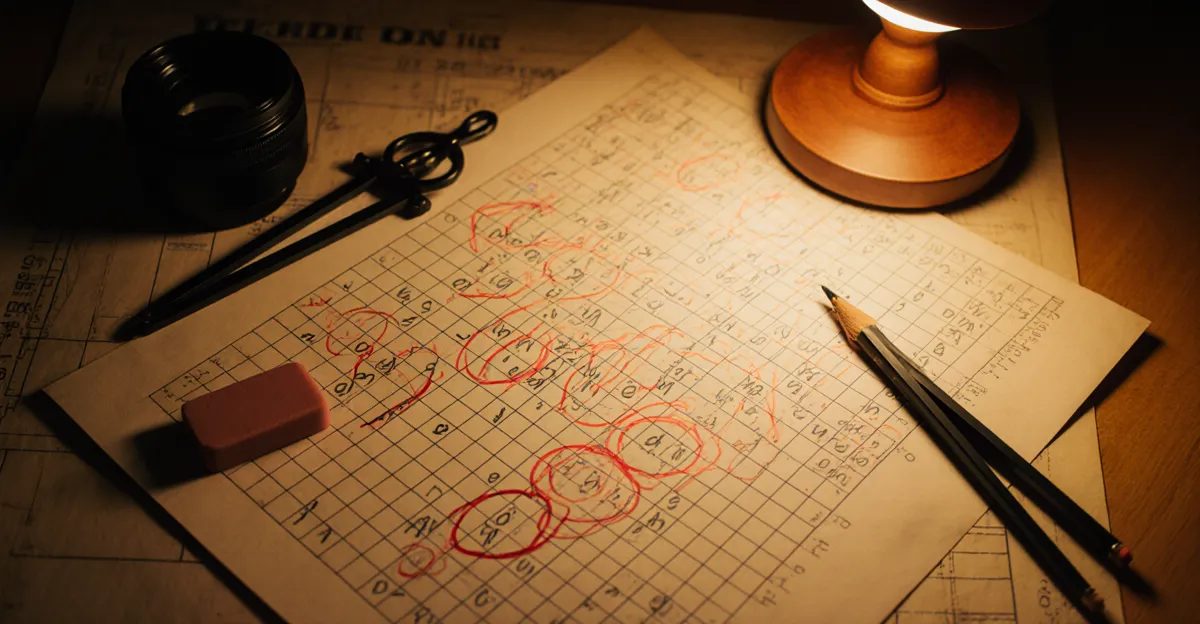
Grid placement is the most technically demanding part of the process. The algorithm tries to place every listed word while ensuring the leftover letters form the murder method when read left to right, top to bottom.
This does not always work on the first attempt. Some word combinations create leftover sequences that are impossible to arrange into the target word. When that happens, we adjust word placement, occasionally swap a word on the list, and try again. Complex cases can take 12–15 iterations before the grid is clean.
Writing the Case Briefing
The briefing is the last thing we write. By the time it is drafted, we know the killer, the method, the location, and every word on the list. The briefing has to give a player all the information they need to solve the case — without making the answer obvious.
We test each briefing by giving it to someone who does not know the solution. If they can narrow it down to two suspects before finding the murder method, the briefing is too transparent. If they have no idea after finding the method, it is too vague. The target: a reader who finds the method and immediately thinks, "Of course — it had to be them."
What Changed in Volume 2
Volume 1 established the format. Volume 2 tested its limits. Grids are denser. Word lists are longer. Several cases use compound suspects — "The Butler's Assistant" instead of just "Butler" — which dramatically increases the difficulty of the leftover-letter decode.
We also introduced a new design rule in Volume 2: at least three words on every list must be genuine red herrings — objects or actions that could be the murder method but are not. Player feedback from Volume 1 showed that experienced solvers were finding the method too quickly by elimination. Volume 2 makes them work for it.
Detective Club membership required to play.
Play a Case and See for Yourself